A Shakespearean Guide to London

Date
December 29, 2025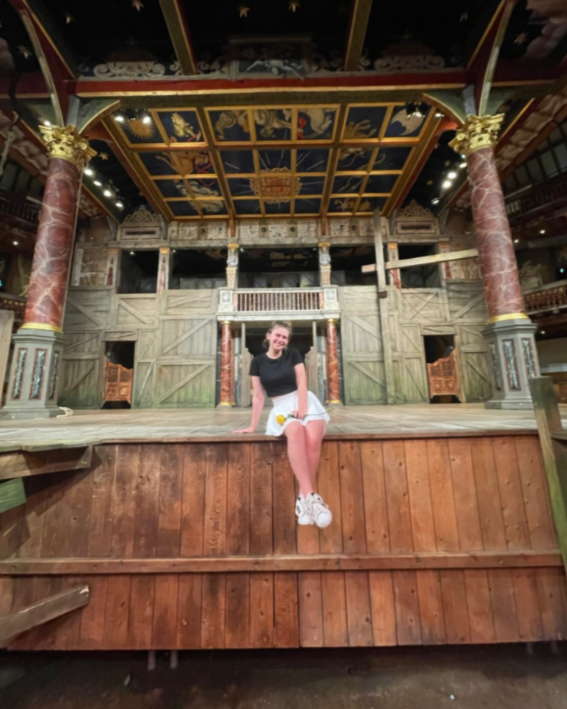
“All the world’s a stage, and all the men and women merely players” (As You Like It, Act II, Scene VII)
The Globe Theatre
The feeling you experience when you stand on the Globe Theatre stage is indescribable. I am one of the lucky ones who knows what it feels like. When I traveled to London in the summer of 2023 with my WashU Ampersand class and stepped on the Globe Theatre's stage, I knew that I would return over and over again. And that I did! I returned a little more than a year later for my semester abroad at Queen Mary's. When I visited the Globe Theatre in the fall of 2024, it felt like a homecoming. You can feel the magic in the air when you step into the round theatre. You can feel the legacy soaked into every wooden plank. You can feel the hush over the audience before the play begins. It is nothing short of extraordinary.
Throughout my time in London, I have taken every opportunity to explore my love of Shakespeare outside of the classroom. Sometimes, I would purposefully seek these places out, and sometimes, I would organically stumble upon them. These spots speak to the magic I feel when I am at the Globe Theatre, whether on stage or in the audience. They are full of life and legacy and love that speaks across time. I want to share this magic with everyone because it is only when we go to these places that we feel Shakespeare and his work come alive.
“There’s rosemary, that’s for remembrance. Pray you, love, remember” (Hamlet Act IV, Scene V)
“Ophelia” by Sir John Everett Millais – Tate Britain
This painting holds a very special place not only in my heart, but in the wider community of Shakespeare studies. Not only is it an iconic piece of art, but it also single-handedly altered the way that people think about Ophelia's death scene. What images do you see when you think about Ophelia's death? She is ethereal, more mystical than human. You can feel the chilly brook water and the soft petals of the daisies and violets floating close to her. Ophelia feels just out of our reach, like we are helpless to rescue her or stop the hands of fate. She is the picture of a life lost too soon. Although, where does this image come from? Shakespeare gives very little detail about Ophelia's death since it happens off-screen, and the audience has very little time to process her death since they are immediately swept into the ending fight between Hamlet and Laertes. Almost every adaptation or performance of Hamlet depicts Ophelia in the same way that Sir John Everett Millais did. He has shaped the way that society thinks about Ophelia. This painting was one of the very first paintings I saw when I went to London for the first time in 2023. I was
mesmerized by it because one could look at Sir John Everett Millais' painting for hours and continue to notice new details from the tiniest brush stroke. He reveals Ophelia's intimate death to us in a way that Shakespeare never did. In some way, Sir John Everett Millais keeps Ophelia alive through art.
"If we shadows have offended, think but this, and all is mended, that you have but slumbered here while these visions did appear" (A Midsummer Night's Dream Act V, Scene I)
The Great Hall - Hampton Court Palace
While it does require a train ride away, Hampton Court Palace is still considered part of London since it is in the London Borough of Richmond upon Thames. And I promise that it is totally worth the train ride! Hampton Court Palace is most known for being the lavish home of King Henry VIII and his six wives. Although, since I am a Shakespeare scholar, I do have to state that Hampton Court Palace is one of the only places still standing where Shakespeare's troupe - the King's Men - performed. While they did perform at the Globe, the location of the Globe Theatre today is not in the same spot. The original Globe burned down in 1613 due to a misfired theatrical cannon in the middle of a performance. While Hampton Court Palace did not have a traditional theatre space until the 1700s, it did have the Great Hall, which was traditionally used for plays, dances, and masques. It was here that the King's Men performed A Midsummer Night's Dream for King James I and his court in 1604. In the Great Hall, you can almost hear the voices of the King's Men saying lines about fairies and mistaken identities and true love. When I visited Hampton Court Palace, I was overcome with emotion standing in that room. During my Ampersand program, I played Hermia in a scene from A Midsummer Night's Dream. It was here that Hermia leapt off the page and became real. When I walked into the gardens on the property, I was waiting for Hermia to come running through the bushes to chase after Lysander.
"Mine eye hath played the painter and hath stelled thy beauty's form in table of my heart" (Sonnet 24)
"William Shakespeare" by John Taylor - The National Portrait Gallery
While author photos are considered an expected inclusion in modern books, that was not always the case. It was not until the mid-1800s that publishing companies began to include an author's photo in their novels. You might have noticed in your modern Folger or Arden Shakespeare copies that Shakespeare does have an author's photo. His author's photo is actually a portrait attributed to John Taylor. It was painted between 1600 - 1610, during which Shakespeare was writing plays like Twelfth Night and King Lear. What makes this portrait special is that it is the only portrait of Shakespeare that was painted while he was alive. The painting is comprised of deep blacks and rich browns. It plainly and simply depicts Shakespeare as he is. He looks like a man, nothing more and nothing less. When I sat with this painting in The National Portrait Gallery, I kept asking myself, "Did this man know that people would travel from all over the world just to catch a glimpse of his portrait?". We know very little about Shakespeare, so this question is probably unanswerable. However, it did make me think about how easy it can be to forget that this giant was a real person who put his heart and soul into his creative work, like me. We are connected by a passion for writing, even if there are 400 years between us. Every time I open up my copy of The Taming of the Shrew to pull a quote for my thesis paper, I remember that Shakespeare was just a man, even if he is one of the most famous playwrights in the entire world.
"By the pricking of my thumbs, something wicked this way comes" (Macbeth Act IV, Scene I)
"The Witches in Macbeth" by Alexandre-Gabriel Decamps - The Wallace Collection
While walking through the rooms of The Wallace Collection, I saw these three witches plotting out of the corner of my eye, and I instantly knew that it was the witches from Macbeth. It piqued my interest because I quickly realized something peculiar. This painting is one where the witches maintain this inhuman quality that aligns with Shakespeare's text. Banquo states that the witches are not human, and instead, supernatural beings who do not conform to ordinary human characteristics. When I look at the faces of the witches, I feel like I am looking at the physical embodiment of the uncanny. They appear ancient and eternal and timeless. I can feel the heat from the fire on my skin and hear the caldron bubbling with anticipation. We are let into this private moment, one that is not accessible to humans without a cost (one that Macbeth learns of very quickly). The audience becomes the character of Macbeth, waiting anxiously for our fortune to be revealed when the steam from the potion dissipates. However, unlike Macbeth, we are left guessing since we are unable to ask the witches ourselves. Instead, we can only look on and wonder what our fortune holds. However, if Macbeth has taught me anything, maybe that is a good thing! I am glad that a frame separates me from these witches because my time in London has taught me that the future is what we make of it.
"Knowing I loved my book, he furnished me from mine own library with volumes that I prize about my dukedom" (The Tempest Act I, Scene II)
The Folios - The British Library
What English major can turn down a library? That was how I found myself in the British Library and coming face-to-face with a collection of Shakespeare's Folios. While Shakespeare was alive, his plays were only published in quartos, inexpensive and small sheets of paper for the general public to consume. After his death, two of Shakespeare's colleagues put together the First Folio in 1623, which included about 36 of Shakespeare's plays. Today, it is considered one of the most influential books ever published and the holy grail in Shakespeare studies. This is because the First Folio is the closest modern audiences can get to the plays as they were when Shakespeare wrote them. There are 235 known, surviving First Folios today, and one of those is on display at The British Library. There is something special about seeing the First Folio for the first time as a Shakespeare scholar. I could spend hours examining the First Folio because of the profound impact it has had on my life, both personal and professional. The First Folio is not just another old book. It is the literal living embodiment of all of Shakespeare's plays. It is about preservation because without this book, we would not have the same access to Shakespeare's plays today. The First Folio reminds us about the importance of keeping Shakespeare's works alive for the next generation.
"I shall see some squeaking Cleopatra boy my greatness i' th' posture of a whore" (Antony and Cleopatra Act V, Scene II)
Cleopatra's Outfits - The Victoria and Albert Museum, South Kensington
Sometimes, it can be easy to forget that Shakespeare is not simply an author. He is a playwright and his work is meant to be seen on stage, not just read on paper. Even if you do not enjoy reading Shakespeare's work in your English Literature classes, I still encourage people to see one of his plays acted out on stage, as it changes the way we interact with the text. You feel like the characters are real, and one of the best ways to do this is through costumes. The Victoria and Albert Museum recognizes this because it preserves many costumes from old Shakespeare performances. I want to call attention to the Cleopatra costumes from two productions of Antony and Cleopatra. Although it is a play that does not receive much attention, it is one of my favorites, so I was so elated when I saw how much attention to detail the V&A gave to preserving these beautiful costumes. The feathered cloak worn by Vivien Leigh in a 1951 performance of Antony and Cleopatra is absolutely breathtaking in person. This was worn during Cleopatra's death scene (spoiler alert!), where Cleopatra is stated to dress in her finery since she wanted to be remembered as a queen. It was truly made for royalty! The cloak includes that signature orange color that Cleopatra is associated with, which makes Judi Dench's blue costume from a 1987 performance extra special as well. The blue color presents a softer Cleopatra and highlights the mortal that lies behind the title. These costumes work together to show us the two sides of Cleopatra: the queen and the lover. Together, they give us a deeper insight into who the character of Cleopatra truly is.
"Yet he shall have a noble memory" (Coriolanus Act V, Scene VI)
The Shakespeare Stained Glass Window - Southwark Cathedral
As a Catholic, I have seen a lot of stained glass windows in my day. Although until I came to London, I had never seen one based on Shakespeare and his characters! Southwark Cathedral (or what was known as St. Saviour's Church when Shakespeare was alive) was one of the locations where members of the King's Men worshipped. There are debates on whether Shakespeare was Catholic or Protestant; however, that does not take away from the beauty of the stained glass window. The window depicts some of Shakespeare's most well-known characters, from Bottom to Romeo. To me, the most interesting inclusion is the depiction of Prospero from The Tempest. Some scholars suggest that Prospero may be a self-portrait of Shakespeare himself, and Prospero's epilogue is a way for Shakespeare to say goodbye to the theatre, as The Tempest was written towards to end of Shakespeare’s life. In the window, we see this echoed in the way that Prospero stands in the center of all these characters with his arms open wide, almost orchestrating the scenes we see depicted in stained glass. Prospero is the one connecting these characters together and the one shaping the scenes we see here. In a way, Shakespeare himself comes alive whenever someone reads or acts out Prospero's epilogue or even sees him in this stained glass window at Southwark Cathedral. It almost feels like we get to see Shakespeare whenever we see Prospero, whether on stained glass or on page or on stage.
"So long as men can breathe or eyes can see, so long lives this, and this gives life to thee" (Sonnet 18)
Shakespeare Monument by Giovanni Fontana - Leicester Square Gardens
One of my favorite things to do in London was to get off at a random tube station and just walk around to see what I could find. I found countless hidden gems doing this, but one of my favorites is the Shakespeare Monument in Leicester Square Gardens. While it does not draw the crowds that its twin does in Westminster Abbey, there is something about how accessible this statue is. Shakespeare did not write his work for the elite; he wrote it for the everyday people. He wanted his work to be available to all people, just like this statue. Fontana's statue reminds me that we are all a part of Shakespeare's legacy because he wrote these plays for us. When we think about Shakespeare's legacy, it can be so easy to reduce it to the two or three plays we all read in high school. However, by doing that, we forget so much. All of these locations, paintings, books, and so much more are a part of Shakespeare's legacy. They work together to keep his stories alive and accessible to all. It is not just our duty to engage with his work, but to engage in the things found in this guide because it is up to us to keep Shakespeare's legacy alive. Every time someone visits one of these spots, that person becomes an active part in preserving Shakespeare's legacy.
When I registered for my first Shakespeare class in my freshman year, I did not realize how monumental my time in London would be because of Shakespeare. This is probably due because I did not know that I would study Shakespeare in university. However, I quickly fell in love with his stories, and I credit my two study abroad experiences in London with fiercely strengthening that love. Shakespeare has been my lighthouse for the past four years in the stormy waters of my undergraduate years. Now, as I prepare for graduation and what lies beyond, I keep in mind the words that Miranda declares at the end of The Tempest: "O, brave new world!". There is a great, big world out there for me to explore after graduation, and I hope, like Miranda, I am brave enough to embrace it with Shakespeare by my side.
These pieces were created by student contributors. The views and opinions expressed are their own and do not necessarily reflect those of Arcadia Abroad.